

Broad-Winged Hawk
(Buteo platypterus)
Buteos are the largest group of hawks. They have long, broad and rounded wings and short, broad tails. They are able to soar for hours but they usually hunt by the “sitting and waiting” from a tree or utility pole. They eat a wide variety of prey but mice make up the major part of their diet.
The Broad-winged Hawk, one of the smallest North American buteos, has short pointed wings and a relatively long tail.
Ron Walker with a Broad-winged Hawk.
(Click on picture to play video.)
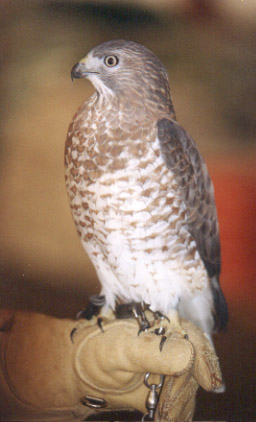
This is one of the most common woodland hawks of eastern North America. They nest in dense deciduous and occasionally in open woodlands near water. The Broad-winged Hawk's nest is 1-1.5 feet diameter and usually in crotch of a deciduous tree. It is made of relatively small sticks, twigs and dead leaves. It has a lining of with inner bark strips, lichens, few outer bark chips, evergreen sprigs and green leaves. The two to three eggs are bluish-white and marked with brown.
The pair's bond occasionally lasts more than one year. Only the female has a brood patch. The male provides food for his incubating mate. Young hatch on different days, asynchronously -- therefore the chick sizes differ. Raccoons and crows prey upon the eggs and young. Fresh sprigs of greenery added to nest during incubation and nestling phases. One theory is that the sprigs contain chemicals that inhibit the survival of ectoparasites in the nest.
Broad wings are opportunistic feeders. They still-hunt from perches and their diet consists of about 56 percent mammals, 38 percent birds, some amphibians, reptiles and insects.
Broad wings winter in Central & South America. They often migrate in large flocks ("kettles"). More than any other hawk, broad wings depend on the right weather conditions to migrate. In general, good thermals accompanied by a tail- or cross-wind are ideal weather for broad wing migration.
There isn't any evidence of significant population changes in this species. It seems to have avoided major population losses during the years of hard pesticides. The destruction of its winter habitat, the tropical forests of South America, may affect it in the near future.