AP Physics Lab
Diffraction and Interference
Caution: Lasers are used in this experiment. Under no circumstances should you look directly into the laser or at its reflected light.
Introduction
In this experiment the wave properties of light will be studied. Since the waves are too small to be seen directly, you will observe the phenomena of interference and diffraction to find the wavelength of the laser light. Also, you will attempt to measure the thickness of a human hair and the distance between the spaces on a compact disc (CD).
Light is a wave and thus has a wavelength. White light consists of a continuous spectrum of all visible colors (ROYGBIV), each with a distinct wavelength. Lasers have one specific wavelength; the laser used in this lab has He-Ne gases which produce a wavelength of approximately 634 nm.
In this experiment, you will look
at different slit combinations through which light passes. From
your data you will be able to characterize the properties of
interference and diffraction through various slits, and calculate
a wavelength for light from these properties.
Consider two slits separated by a distance d. Light emerges from each slit and travels to the screen which is a relatively large distance (L) away. Each ray travels approximately the same angle to the horizontal.
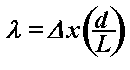
Analysis of double slit interference pattern (see below also).
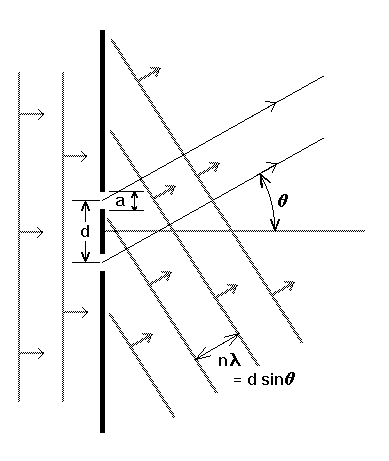
Thus, d Sinq = n l and d x / L = n l
Note that x m /L equals Sinq, values that are more easily measured. These equations indicate that the bright and dark bands are equally spaced (since m = 1, 2, 3, etc.). [Because of the response of the human eye, the dark bands will appear narrower than the bright fringes.]
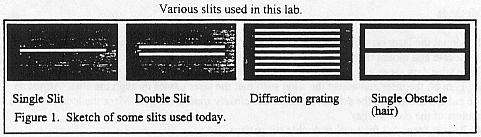
A diffraction grating consists of a large number of slits equally spaced and can be analyzed using the above equations. Most diffraction gratings are described by the slits per cm.
When a single slit is used the analysis is more complicated, but the ideas of interference remain valid (see figure below). The first case of destructive interference (dark spot) occurs when the light from the top half interferes with the light from the bottom half of the slit.
Methods
1. Mount the laser on the adjustable jack with the slit holder and viewing screen 100 cm apart.
2. Locate and mount the slide containing the double slit patterns and record the distance (d) between slits. Tape your data sheet to the screen and record the distance (L).
3. Turn on the laser and adjust the slide such that the laser passes through the slits. Adjust so the pattern is clear on the screen. Look for the closely spaced fringes. Mark the locations of the centers of the bright fringes.
4. Find the single slit pattern and mount it on the setup. Tape a new piece of paper on the screen and sketch the pattern. Adjust the screen distance and note the results. Mark the locations of the centers of the bright fringes.
5. Mount the diffraction grating and pass the laser light through. Record the pattern on a new piece of paper. Record the number of slits/cm. Mark the central bright spot and several bright spots on either side of center.
6. Tape a hair vertically across a slide and adjust the laser to hit the hair. Sketch the pattern on a new piece of paper and record the location of the first bright spot on each side of center.
7. Record the necessary data for determining the spacing between ridges of the laser reflecting off the compact disc.
Analysis
1. Determine the wavelength of the laser using data from the double slits.
2. For the single slit, describe how the screen distance affects the pattern.
3. Determine the wavelength of the laser using data from the diffraction grating. Calculate % error ( = 634 nm)
4. Determine the thickness of the hair. (Hint: what pattern does it display?)
5. Determine the spacing between the ridges on the compact disc.
Back to the Brockport High School Science Department