|
I have read two novels that deal with the poor rebelling against the rich. One is called A Tale of Two Cities, and the other is called The Grapes of Wrath. Perhaps you have read them. I haven’t read these stories recently, but I recall an incident at the beginning of A Tale of Two Cities. The carriage of a wealthy person runs over a small child. The child was killed, and it is evident that the carriage driver was at fault. He was going too fast through a town, and put the children of the town at risk by his carelessness. To appease the family of the child, the wealthy person simply tossed a gold coin out the window of the carriage and had the driver speed him on his way once again. The incident describes the divide between rich and poor just prior to the French Revolution. I think God would condemn the attitude this incident describes, and I think God would condemn the revolution that followed. I think God would also condemn the conditions of the impoverished described in the Grapes of Wrath, and the violence those conditions produced. On pages 88 and 89 of a publication called Vital Signs 2003, it says, “Of all high-income nations, the United States has the most unequal distribution of income, with over 30 percent of income in the hands of the richest 10 percent and only 1.8 percent going to the poorest 10 percent” The gap between rich and poor in the United States is larger than it has been in the past seventy years. Here are some statistics published by the Congressional Budget Office. “In 1979, the top 1% received just 7.5% of national income, compared to 15.5% in 2000.” “The share of the poorest 40%, in contrast, declined from 19.1% to 14.6%.” “The income going to the richest 1% has gone up threefold in real terms in the past twenty years, while the income of the poorest 40% went up by a more modest 11%.” Only the top fifth increased their share, with their real incomes going up by 68%. 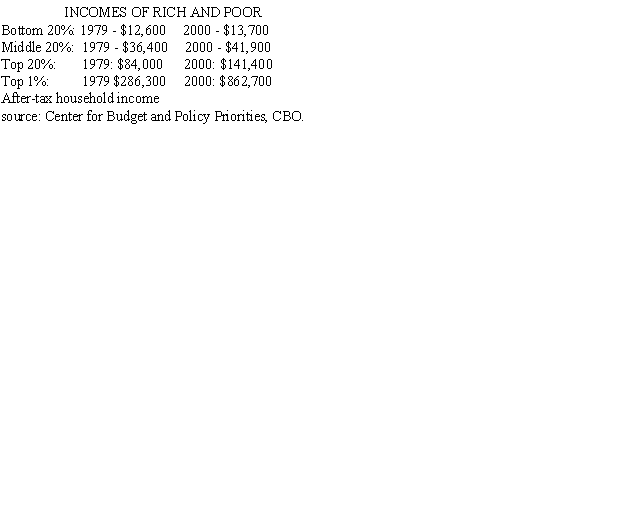
The wealthy have benefited from salary increases and from favorable tax policies. “The effective Federal tax rate on the top 1% dropped from 37% in 1979 to 33.2% in 2000.” So far I have tried only to explain the situation in our nation. With many in the world existing on less than a dollar per day, the gap between rich and poor worldwide is astounding. One political party says we need tax cuts to stimulate the economy. The other party says our deficit is too high. Neither side sees this as a moral issue. There is a theme in our scripture. God is concerned about the fate of the widow and the orphan. We are to be concerned about the welfare of our neighbor. Our world has gotten smaller. We now have neighbors all around the globe. This is not an issue that should divide Democrats and Republicans; this is an issue that ought to concern all Christians. In the sixteenth Chapter of Luke, Jesus told the story of a rich man and Lazarus. At one point in the story, Abraham says these words to the rich man, “Child, remember that during your lifetime you received your good things, and Lazarus in like manner evil things; but now he is comforted here, and you are in agony.” The rich man was in hell. Abraham was in the process of telling him that he was destined to always be there. The rich man didn’t seem like that bad of a guy. His only crime as far as I know was a lack of concern about Lazarus. I’m sure that you don’t want to hear the words that Abraham spoke to that rich man. I don’t want to hear them either. I am concerned about the growing divide between the rich and the poor. I think it needs to change. I don’t feel that a revolt is right around the corner, but a revolt would not surprise me all that much. I’m not worried about going to hell, because I have confidence in Jesus forgiving my sins, even the sin of not caring about my neighbor. I am concerned because I believe God is concerned, and I believe God is not pleased with the current situation. If we have the resources to provide our own food, shelter, transportation, clothing and even a few luxuries, then God expects us to also care for those who do not have enough. How you do that is up to you, but God expects you to help, and there is real danger in not helping. This is not a political issue. This is a moral issue. If we are concerned about the Ten Commandment controversy in Duluth, we should be concerned about this issue too. If we ignore this growing divide, we do so at our own peril. Thanks for listening. Sincerely, Pastor Birk |