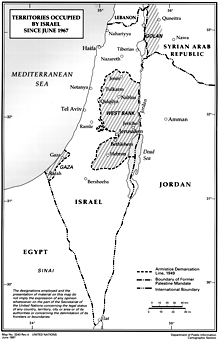
Israel & Palestine.

The struggle between Jewish and Arab interests over the area has origins dating back to the 1880's, with tensions centring on the city of Jerusalem - sacred to Jews, Christians and Muslims alike. Israel claims Jerusalem as its capital, but this is not recognised by the Palestinians or the United Nations.

The creation of Israel was the culmination of the Zionist movement, whose aim was a homeland for Jews scattered all over the world following the Diaspora. After the Nazi Holocaust, pressure grew for the international recognition of a Jewish state, and in 1948 Israel came into being.

Much of the history of the region since that time has been one of conflict between Israel on one side and Palestinians, represented by the Palestine Liberation Organization, and Israel's Arab neighbours, on the other. Thousands of Palestinians were displaced, and several wars were fought involving Egypt, Jordan, Syria and Lebanon.

In 1979 Egypt and Israel signed a peace agreement, but it wasn't until the early 1990s, after years of an uprising known as the intifada, that a peace process began with the Palestinians. Despite the hand-over of parts of the West Bank and the Gaza Strip to Palestinian control, a "final status" agreement has yet to be reached.

(BBC News Online: World: Middle East: Country profiles, Thursday, 27 September, 2001.)

click here for enlarged view of map


Late breaking news on the crisis in the Middle East:

Al Bawaba

The Alternative Information Center

Guardian Unlimited: Special Report on Israel & the Middle East

Ha'aretz

Human Rights Watch

War Reports

Palestine IMC*

ZNET Mideast Watch


ADDITIONAL RESOURCES

Bitterlemons.org
Presents Israeli and Palestinian viewpoints on prominent issues of concern.

Coalition of Women for Peace
Two states for two nations: Palestine side by side with Israel.


Middle East Information and Research Project


Israel/Palestine Center for Research and Information
Based in Jerusalem, this centre is the 'only joint Palestinian-Israeli public policy think-tank in the world. It is devoted to developing practical solutions for the Israeli-Palestinian conflict.' Information on the site includes details of its publications and related links.


Promoting Joint Thinking in International Conflicts: An Israeli-Palestinian Continuing Workshop
By Nadim N. Rouhana and Herbert C. Kelman A discussion of the development of interactive problem solving as an 'unofficial' approach to the resolution of international conflicts, in the case of the Israeli--Palestinian conflict.


Palestine/Israel Journal
A quarterly publication written by an equal number of Israeli and Palestinian contributors, to provide the most balanced academic work in the region. Previous volumes include 'Women and Conflict', 'Children and Conflict', and 'Psychological Dimensions of the Conflict'.


Political Web Sites from the Entire Israeli and Zionist Spectrum of Opinion & Resources
A list of links to many of the organisations and groups operating in Israel, many of which are associated with the themes of peace and conflict resolution. This site is updated regularly.

THE ELECTRONIC INTIFADA
will equip you to challenge myth, distortion and spin in the media in an informed way, enabling you to effect positive changes in media coverage of the Palestinians and the Israeli-Palestinian Conflict.


The People to People Program
A Norway facilitated programme which provides information on all of the Palestinian and Israeli NGO's working in co-operation with each other at present. Also offers information on each of the new joint projects set up for 1998/99.


Search for Common Ground in the Middle East
Addresses issues of diplomacy, security, economics, and civil society through a number of working groups, with one group's work focusing solely on conflict resolution. Publishes a quarterly bulletin.


Peace Agreements
INCORE's Peace Agreements section provides the text of a wide range of agreements. These include the Camp David Accords, the Israeli-Palestinian Interim Agreement and the Wye River Memorandum. The agreements can be downloaded in pdf format.


ARTICLES

Challenging Ourselves on Israel and Palestine
by Dennis Fox

Israelis Held Hostage By Settlements
MASADA, Israel — After a week of traveling up and down Israel, I've found it to be a nation mired in a despair it has never known. by Tom Ackerman

What Israel has done Can Israel be a state like all others? That is the true question of its existence by Edward Said

Ignorance Is Strength The Mainstream Media And The Israeli - Palestinian Conflict by David Edwards

Blindness and Madness Israeli and Palestinian leaders are teaching President Bush a painful lesson about the cost of neglect and obsession. By Todd Gitlin

Israeli Offensive May Transform US Judaism
By Ira Chernus

'You Won't Break Them' An Open Letter to General Ariel Sharon By Breyten Breytenbach

The Big Lie: Palestine, Palestinians and International Law By Francis A. Boyle

What Price Oslo? By Edward Said

Sharon must heed his ally Israel will only listen to the US

The lies leaders tell when they want to go to war By Robert Fisk The problem with Arafat is that he has a lot in common with Sharon: old, ruthless and cynical

Watching from on high as Israeli guns keep firing
From Psagot, in the West Bank
By Robert Fisk

The Murder Of Arafat By Uri Avnery

It's The Occupation By Bill thompson

The Nightmare in Israel By Alexander Cockburn

Israel's choice By Ali Abunimah

Personal Testimony of an Israeli Refusenik By Asaf Oron Asaf Oron, a Sergeant Major in the Giv'ati Brigade, is one of the original 53 Israeli soldiers who signed the "Fighters' Letter" declaring that from now on they will refuse to serve in the Occupied territories. He is signer #8 and one of the first in the list to include a statement explaining his action. (There are 251 signers as of February 17, 2002.) Below is the translation of Oron's statement by Ami Kronfeld of Jewish Peace News.

Israel Must End the Occupation By Robert Jensen While I was standing at the edge of a recent campus rally in support of the Palestinian cause, students supporting Israel passed out fliers. One of those students and I engaged in a spirited exchange that made it clear how different were our accounts of the problem and potential solutions. One of her points was that Palestinians have to prove they are serious about peace.

The screw turns, again By Edward Said It falls to the victim to show new paths of resistance

Israel's conscience By Anne Karpf Diaspora Jews are asked to support the state, but some are backing acts of Israeli opposition to the occupation

What's so surprising?By Uzi Benziman Israel's diplomatic-public relations effort is now focused on trying to exploit the impressive operational success that culminated in the capture of the Palestinian arms-smuggling boat. This campaign has yet to reach its peak: A major state-sponsored exhibition is likely to be staged today in Eilat today, and it will be designed to propound Israel's version of the ship-capturing event in the court of world opinion...

Palestinians Should Switch to Soothing Israelis' Valid Fears By David K. Shipler (January 8, 2002) CHEVY CHASE, Maryland — Twenty years ago a young Palestinian-American named Mubarak Awad appeared in Jerusalem preaching nonviolence. Palestinians laughed him into obscurity. Israeli officials took him more seriously, eventually jailed him and deported him, and again last summer denied him entry into the country. The Israelis knew what the Palestinians did not: The Israeli occupation could be killed with kindness.

Is Israel more secure now? By Edward Said (January 4, 2002)

Nonviolence: direct action for peace By Gila Svirsky (January 3, 2002) Sporadic initiatives of nonviolent direct action have marked the efforts by the Israeli peace movement to end the occupation for many years. In addition to the usual demonstrations - some more dramatically executed than others - nonviolent direct actions in the early years included hunger strikes, the planting of olive trees where forbidden, painting anti-occupation graffiti on tanks, blocking bulldozers that came to demolish homes, meeting illegally and publicly with members of the PLO, and conscientious objection to compulsory army service. However, with the exception of Yesh Gvul (Hebrew for "There is a limit!") and its ongoing campaign to encourage soldiers to refuse to serve in the territories, nonviolent direct action was not a significant or regular element in the activity of the Israeli peace movement until this recent intifada.

The war they wanted By Alexander Cockburn Isreal stoked the anti-Islamic fire to secure U.S. support

The Final Push to Defeat the Palestinians By Jeff Halper of ICAHD

The Making of a Suicide Attacker: Are Palestinians Human? By Sam Bahour and Leila Bahour

Sharon or Arafat:Which Is the Sponsor of Terror?
By Alexander Cockburn

Stopping The Hamas Suicide Bombers
By Ross Dunn Jerusalem - The Israeli-Palestinian conflict has been brought to a dramatic crossroads by another wave of suicide bombing attacks. VOA's Ross Dunn reports from the Gaza Strip on a cult that is spreading terror around the world, but most frequently in the Holy Land.

Israel must resist its rage over such horrific attacks and temper its response

Palestinian terrorists are desperate, not cowardly By Peter Preston Israel poses a more intractable problem than Osama bin Laden

MERIP Primer on the UPRISING IN PALESTINE
From the Middle East Information and Research Project

'I saw a boy of 10 breathe his last breath' By Phil Reeves in Jerusalem Jerusalem bombing » Witnesses to shopping centre horror tell their stories

Sabra and Chatila Massacres: After 19 years, The Truth at Last? By Robert Fisk

Vanished victims of Israelis return to accuse Sharon
By Julie Flint

Say No to a Palestinian 'State'
By Ran HaCohen Imagine the following scenario: after ages of discrimination, the United States decides to compensate African-Americans generously and to solve their problems once and for all. All African-Americans are locked up in prison, and the prisons are declared to be an independent African-American state. Sound crazy? That is just what the US and Israel are now planning – for the Palestinians...

Shifting Frontiers of the Middle-East
Redefining of borders from 1920 - 2001

Jerusalem: The Barrier to Mid-East Peace
Part I- Brief History The first mention of the city of Jerusalem in any historical record occurs on vases that date from the reign of Pharaoh Sesostris III (1878-1842 B.C.). The vases include the names of nineteen Canaanite cities, one of which is Rushalimum, (Karen Armstrong, Jerusalem) also written as Urshamen, Rashlemum, Ershalem and Urusalim. The latter name is almost identical with the Hebrew Jerushalem which means either "foundation of the God Salem" or "Foundation of Peace." (Jerusalem, City of Mirrors, Amos Elon). Karen Armstrong translates "Rushalimum" to mean "Shalem has founded" and identifies Shalem as a Syrian God of the setting sun or evening star...

Prospects for Peace in the Middle East
by Noam Chomsky Presented at the First Annual Maryse Mikhail Lecture “No peace without justice; no justice without truth” The University of Toledo, March 4, 2001


Israel and the Arab-Israeil Conflict: A Brief Guide to the Perplexed

By David A. Harris As the magnitude of the horrific events of September 11 sinks in and our nation implements its multifaceted military, diplomatic, and economic response, greater public attention is once again being paid to the Middle East—in the media, on college campuses, and elsewhere. Unfortunately, much of this discussion is misinformed and lacks historical context. This paper provides some perspectives and talking points, both historical and contemporary. It is not intended as an exhaustive examination of the subject...


Credentials For Hatred And Hegemony And Islamic Protestantism
By Dr Fereydun Hilmi Ask anyone and they will tell you that people hate each other because of some aggressive or humiliating action they suffer at the hands of those they develop hatred for. Feuds are normally over land, honour or blood.

It was from this point of view that I tried to understand the Arabs' hatred of the Kurds. I wanted to find out the root causes of the Iraqi Genocidal tendencies towards the Kurdish nation. Why do they support so much the rights of the Palestinians and other Arabs as well as Muslims to lead independent and free lives each in their own little or big state while they vehemently oppose any attempt by the Kurds to enjoy a similar existence.

IndyMedia: Israel: A State of Occupation.
What are the real roots of the conflict between the state of Israel and the Palestinian people? The truth has been lied about, twisted, and suppressed by the U.S. government and media. Often they picture the conflict as a battle between religions. Sometimes they portray any opponents of Israel as anti-Semites. The U.S. puts itself forward as a \"honest broker\" between the two sides who should \"make peace\" and \"share the land.\" At the same time, the U.S. blames the current clashes on the Palestinians --even though almost all the casualties have been Palestinians killed and wounded by the heavily armed Israeli forces...


The Peace Process and Political Violence
By Khalil Shikaki This article is based on about 30 surveys of Palestinian public opinion, which were conducted by the Palestine Center for Research Studies, and traces the shift in attitudes by Palestinians in the recent years.