Images of Spherical (Curved) Mirrors
Obj: Observe images and use lens equation with
spherical mirrors
Materials: mirrors, meter stick, screen, candle
Methods, Results, and Analysis
A. Focal
length of concave (converging) mirror 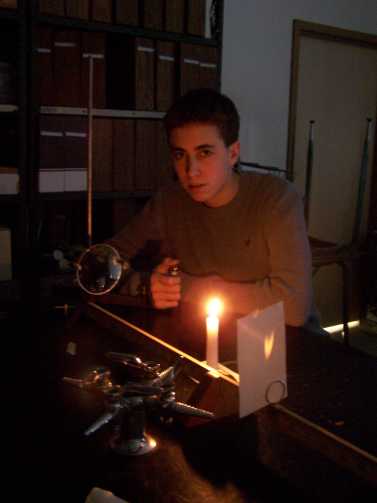
B. Real Images of a concave mirror
1. Place the
candle (object) at a distance several cm beyond C. Move the screen until you obtain a sharp
image . Record the position (do),
relative size (ho), and orientation of the object and image (di, hi). Use the mirror equation to verify the focal
length.
2. Place the
candle at a distance equal to 2f. Move
the screen until you obtain a sharp image.
Record the position, size, and orientation of the object and image. Use the mirror equation to verify
approximately the focal length. This
condition (object at C equals image at C ) is considered the best measurement
for the focal length. Compare with f in
Part A.
3. Place the
candle at a position that is midway between f and C. Move the screen until you obtain a sharp
image. Record the position, relative
size, and orientation of the object and image.
Use the mirror equation to verify approximately the focal length.
C. Virtual
Images of a concave mirror
1. Move
the candle until it is inside 1f. Try
to locate the image on the screen.
Observe the image in the mirror. Record the location, relative size,
and orientation of the object and image.
D. Convex
Mirrors
1. Examine the image in a convex, diverging mirror. How is it similar to and different from a plane mirror and a concave mirror? Explain the phrase on the passenger side mirror of automobiles, “Objects in mirror are closer than they appear.”
Back to the Brockport High School Science Department