I mentioned in the introduction that the main goal of this project was
to build a "fun" kayak.
And this time, my definition of 'fun' is a
maneuverable hull that is very responsive to paddler input, but still
has room for my winter boots.
Other complaints that I have about my other kayaks is not enough volume
in the ends of the hull. I paddle in the sometimes very close-together
waves in Lake Ontario, and often my other hulls will pearl while
surfing the bigger waves. Then it's an automatic broach.
I have started my design by reviewing the design of my Greenland
qajariaq. I have paddled many miles in this kayak, in a variety of
conditions, so I am well acquainted with it's strengths and weaknesses.
I have chosen to use the KayakFoundry software by Ross Leidy. Through
the interface, the user may manipulate the hull shape, and then
evaluate the results. After twenty or thirty iterations, here is what I
have decided to build:
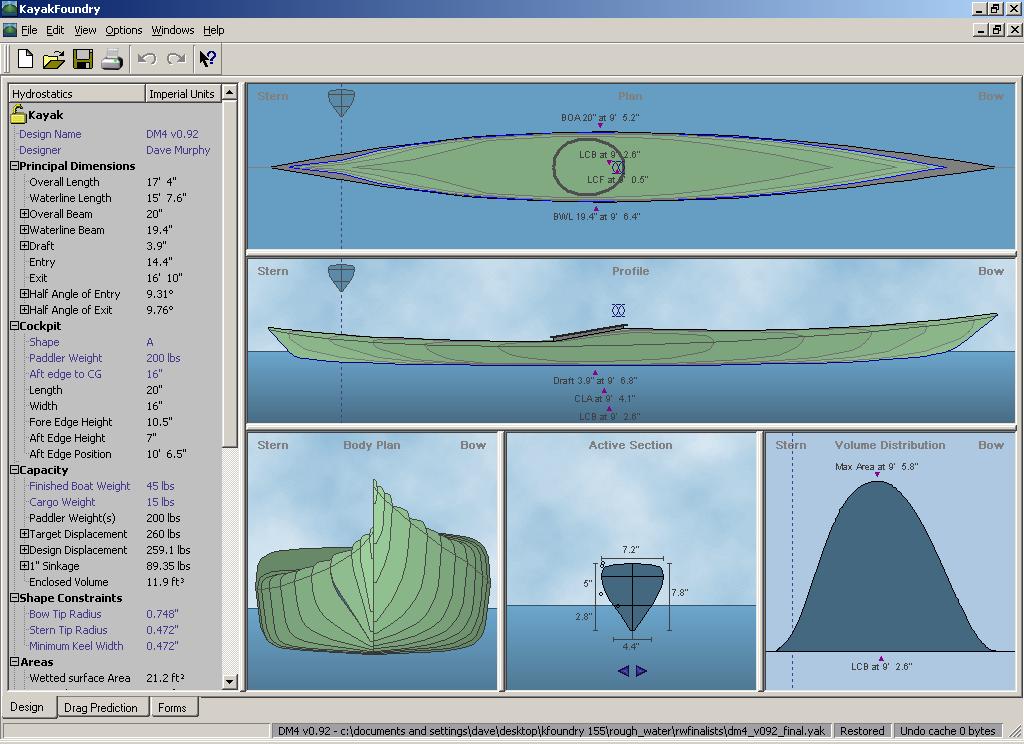
I chose 17'4" OAL by 20" BOA. There is not much
flare, the idea being to provide decent BWL while keeping the shear out
of the way. The shear has been shaped upward, to provide more reserve
bouyancy while in waves, and to provide more righting moment when the
hull is on it's side.
The deckplan is shaped completely convex. This allows for more volume
to be distributed toward the ends, especially the bow. The waterline
aft is a bit pinched due to the vee-shaped sections aft.
The sections go from a full vee at the bow, to round, to somewhat of a
chine just behind the cockpit. I tried to get some shallow arch there
in the middle/aft to help the surfing. Then to a strong vee at the
stern, to act as a natural skeg shape.
There is a lot of rocker in this hull, and CLA is quite close to (but
behind)LCB. For these reasons, I am considering adding a drop-skeg
system.
I do not expect that this will be a fast kayak. Both entry and exit are
quite blunt, and there is a lot of wetted surface for a hull of this
length.