Trial
Well, the Stitch and Glue session was a success. The hull received 9oz
tape on all inside seams, 6 oz cloth on the exterior, and 6 oz cloth on
the interior of the cockpit. The side panels were purposely built 1/4 inch
too high, so that the deckless hull could be properly waterproofed for
a hydrostatic test.
Some explanation: This boat design has never seen water. During the
design phase, various methods were used to determine the fore/aft position
of the paddler. The trouble is, I plan on installing an ocean cockpit.
With a keyhole cockpit, there are a few inches of room for adjustment
of the paddler position. The paddler can ooch forward to get the kayak
to turn better, or sit further back for better tracking. With the ocean
cockpit, there is very little room for adjustment. So, I need to verify
the paddler position.
The plan is to take the boat to the testing tank to see if it sits on
its lines. Well, the testing tank turned out to be Hundred Acre Pond
in Mendon, NY. The local paddling club had a meeting there, which provided
plenty of pairs of eyes to judge trim.
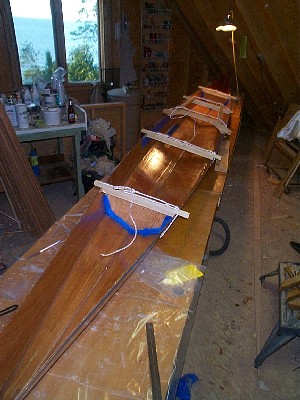 |
I have added temporary deckbeams for support during the trial. All
of the deckbeams feature a line that goes around the outside of the hull,
so that proper shape is maintained. |
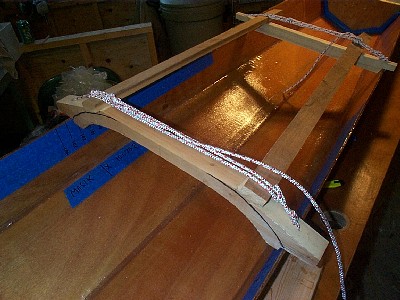 |
There is a trial masik, and markings on a piece of tape to gauge the
results. I have added deck stringers to simulate the deck hump of a finished
kayak. I covered the boat with a temporary deck of .003 polyethylene sheet. |
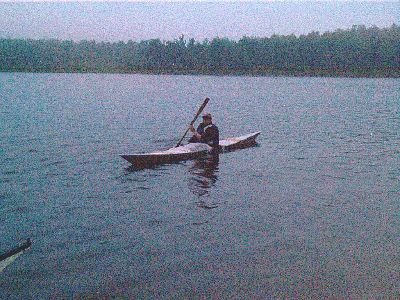 |
It floats! The waterline is where it was expected, but the seating
position needed to be moved by about 3/4 inch to achieve level trim. Sorry
about the grainyness of the photos; The sun was going down, so I had to
do some major adjustments to the JPG file. |
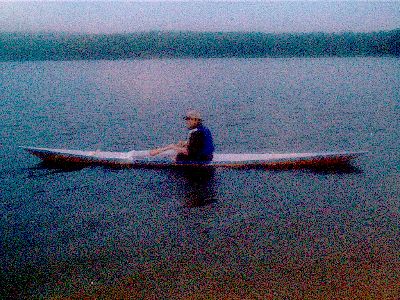 |
A view from the side. |
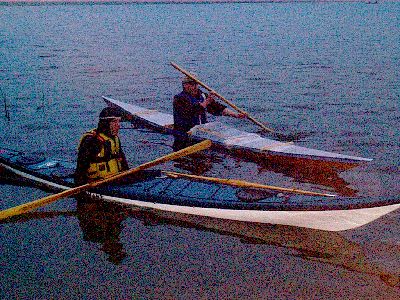 |
For comparison, alongside a Romany. |