Free Graphics Software for the TeX, LaTeX, and PSTricks Community
I've developed some tools while writing a textbook. They're good enough to get real work done, so I'm offering them free under the GPL. Please enjoy and let me know how you fare!
Sketch -- A 3D Scene Description Translator
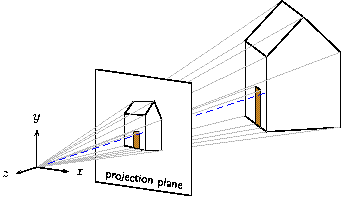
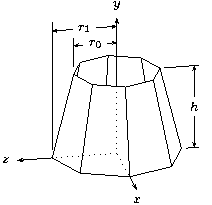
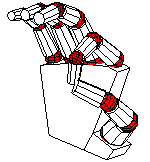
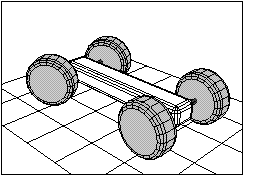
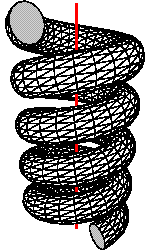
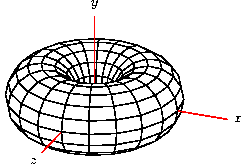
Sketch is a small, simple system for producing line drawings of two- or three-dimensional solid objects and scenes. It began as a way to make illustrations for a textbook after we could find no suitable tool for this purpose. Existing scene processors emphasized GUIs and/or photo-realism, both un-useful to us. We wanted to produce finely wrought, mathematically-based illustrations with no extraneous detail. The input language is reminiscent of PSTricks, so will be easy to learn for current PSTricks users.
Check out our new Google Group sketch-users if you have a question or suggestion. You'll probably get a quicker response if you use this group than if you send email.
MikTeX 2.7 users running out of memory? Sketch pictures with many polygons exceed default storage in MikTeX 2.7 and beyond, and the documentation is not exactly clear about what to do. All the illustrations in the Sketch manual process nicely with the option --extra-mem-top=5000000 given in the latex command. Use a bigger number if necessary!
Important updates to match PSTricks PSTricks version 1.20 added support for setting linejoin style. This interfered with Sketch's output, which set linejoin using pstverb. Graphical quality suffered, with no warnings issued either by latex or Sketch. Sketch 0.2 build 130 and later fix this by producing the new PSTricks linejoin setting. If you like an older PSTricks version, there is no problem! Backward compatibility is supported through the new -V command line option.
New PSTricks Transparency Support The PSTricks option opacity (and its predecessor with the same meaning, transpalpha) for polygons is now understood by Sketch. Thanks to pbmaxi at hoegners dot de for the contribution.
New ConTeXt support (for use with Tikz/PGF). This support is preliminary. Don't hesitate to send bug reports. ConTeXt is an alternative to LaTeX.
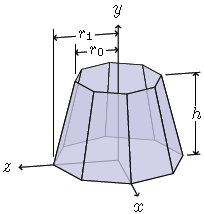
New Tikz/PGF support. In addition to PSTricks, sketch now understands TikZ/PGF options (key/value pairs) and generates TikZ output. Advantages are that TikZ works directly with pdfLaTeX and supports transparency. Happily, the depth sort hidden surface algorithm used by Sketch is perfectly compatible with transparent polygons. See the cone at the right!
Sketch builds easily under Windows and your favorite flavor of Unix. Tested with gcc and cl.
Version 0.3 (build 7), Friday, February 24, 2012 [Update Log]:
On-Line Documentation in HTML.
Documentation in PDF
Download Source and Docs (2.5 Mbyte tar gzip)
Download Source and Docs (2.6 Mbyte zip)
Download Windows binary (80K zip)
XFig (fig2dev) driver for PSTricks
Second is a version of transfig and fig2dev that includes a new driver for PSTricks. It has already been included in WinFig, sources are available on the downloads page. This driver is more complete than fig2pstricks (no disrespect to Chirok Han intended). It converts all the XFig Library/Examples nicely, so it oughtto be reliable. The nice part about this scheme is that LaTeX mathematics and other typesetting can be incorporated directly in your FIG drawings. I would appreciate feedback on how it works for you. Write me at eugene.ressler@frontiernet.net with questions and comments.
Here is the new man page. Here are sample XFig file, LaTeX output, and PDF result.